Forbidden City, Great Wall + slide, 798, Hutongs, Hanging Temple + Yungang Grottoes via Datong (overnight), Tianjin Binhai Library day trip, Tianzi Hotel photo stop.
★ Weather Bureau / Beijing
normal: 18° / 7° · Clear / dry
loading forecast…
★In city(42)
★ EssentialLandmark · Pinned✓ verified
Forbidden City (紫禁城)
also known as The Palace Museum
2 km · 18 min
Imperial palace complex in central Beijing. Residence and political center of Chinese emperors from 1420 to 1924.
Forbidden City. Mandatory in Beijing.
Be the first to commit
★ EssentialCommunist · Suggestion✓ verified
Beijing Exhibition Center (北京展览馆)
also known as Soviet Exhibition Centre (Beijing Exhibition Hall)
6 km · 45 min
Exhibition venue established 1954, built in Sino-Soviet architectural style during the era of Sino-Soviet cooperation.
Stalinist wedding-cake gifted by USSR in 1954. Star-tipped spire, hammer & sickle reliefs. Easy Beijing add.
Be the first to commit
★ EssentialAbandoned/ruin · Suggestion✓ verified
Old Summer Palace / Yuanmingyuan (圆明园)
also known as Old Summer Palace (Yuanmingyuan) ruins
15 km · 45 min
Former Qing imperial garden complex of 3.5 km² ~8 km north-west of Beijing's old Imperial City. Largely destroyed in 1860 by Anglo-French forces during the Second Opium War; preserved as a public ruin park.
Sacked & burned 1860 by Anglo-French troops; deliberately preserved as a ruin/national-shame site. Eerie and political.
Art and history museum on the eastern side of Tiananmen Square. Established in current form in 2003 by merger of the Museum of the Chinese Revolution and the National Museum of Chinese History (which had shared the building since 1959).
World's largest museum by floor area. The colossal 1959 socialist-realist slab on the east side of Tiananmen. Free, takes a passport. Opposite Mao's mausoleum. Skip the contents — the BUILDING is the visit.
Be the first to commit
★ EssentialCommunist dinner-theater · Suggestion
Pyongyang Okryu-gwan (Beijing branch)
8 km · 45 min
STATE-RUN NORTH KOREAN restaurant. Staffed entirely by NK government 'cultural workers' on rotation — they sing, dance, play accordion, and bring you cold noodles. Hard currency goes to the Kim regime. The most surreal communist meal you can have without crossing a border. Branches in Beijing & Shanghai. (Some closed under sanctions; verify before going — but the Beijing one was operating recently.)
Be the first to commit
Food · Pinned
Guo Li Zhuang
5 km · 18 min
All-penis restaurant. Beijing branch is the original. Memorable for the wrong reasons.
Be the first to commit
Food · Pinned✓ verified
King's Joy (京兆尹)
also known as King's Joy
6 km · 45 min
Vegetarian fine-dining restaurant in a traditional courtyard at Wudaoying Hutong, opposite the Lama Temple (Yonghe Temple), Beijing. Three Michelin stars and a Michelin Green Star.
3 Michelin vegetarian, Beijing. Worth it if you skip Ultraviolet.
Taizhou (Zhejiang) seafood and East China Sea fish at the Beijing flagship inside Genesis Beijing's East Tower (Chaoyang). Three Michelin stars in the Beijing guide.
Top-tier Taizhou seafood; Beijing branch is excellent.
Contemporary Chinese tasting-menu restaurant by chef Jason Liu. Beijing original (in the Bei Zhaolong Hotel / Stey co-living space) earned one Michelin star in the 2022 Beijing Guide; a Shanghai sister venue followed.
Modern Chinese tasting, Beijing. 1 Michelin.
Be the first to commit
▮
Food · Pinned
Baoyuan Dumplings Restaurant
8 km · 45 min
Beijing colored dumplings — solid, cheap, iconic.
Be the first to commit
Food · Pinned✓ verified
TRB Hutong
also known as Temple Restaurant
3 km · 18 min
Contemporary French by Ignace Lecleir in a ~600-year-old historic temple courtyard at 23 Shatan North Street, Dongcheng, near the Forbidden City. One Michelin star.
Former state-owned military electronics factory complex with Bauhaus-influenced architecture (built 1954–57) in Beijing's Chaoyang District. Transformed since the late 1990s into one of China's most prominent contemporary art communities.
Beijing Bauhaus factory turned art zone. Easy add.
Be the first to commit
Landmark · Pinned✓ verified
Quanjude (全聚德)
also known as QUANJUDE
0 km · 18 min
Historic Beijing roast (Peking) duck restaurant chain founded in 1864 by Yang Renquan during the Tongzhi reign of the Qing dynasty. Original / flagship branch on Qianmen Street.
Original Beijing roast duck. Touristy but the OG.
Be the first to commit
Food · Pinned
102 House
6 km · 45 min
BEIJING. Conceptual, secret-location-ish tasting menu — the closest thing left to the Ultraviolet ethos in China. Worth swapping in if you're doing a fancy tasting in Beijing instead of Shanghai.
Be the first to commit
Communist/abandoned · Suggestion
Underground City (Dixia Cheng)
0 km · 20 min
Mao-era nuclear bunker network beneath central Beijing. Mostly closed to public but parts pop up; even seeing the entries is worth it.
Be the first to commit
Brutalist-adjacent · Suggestion
National Centre for the Performing Arts (The Egg)
1 km · 20 min
Titanium dome dropped onto the Mao Mausoleum's doorstep. Walk over from Tiananmen.
Be the first to commit
Anti-Brutalist landmark · Suggestion
Galaxy SOHO
3 km · 20 min
Zaha Hadid's flowing white pods — ideal contrast to the Soviet stuff.
Be the first to commit
Iconic · Suggestion
CCTV Headquarters ("Big Pants")
6 km · 45 min
OMA's gravity-defying loop. Polarizing icon of post-2008 Beijing.
Be the first to commit
Communist-era spectacle · Suggestion✓ verified
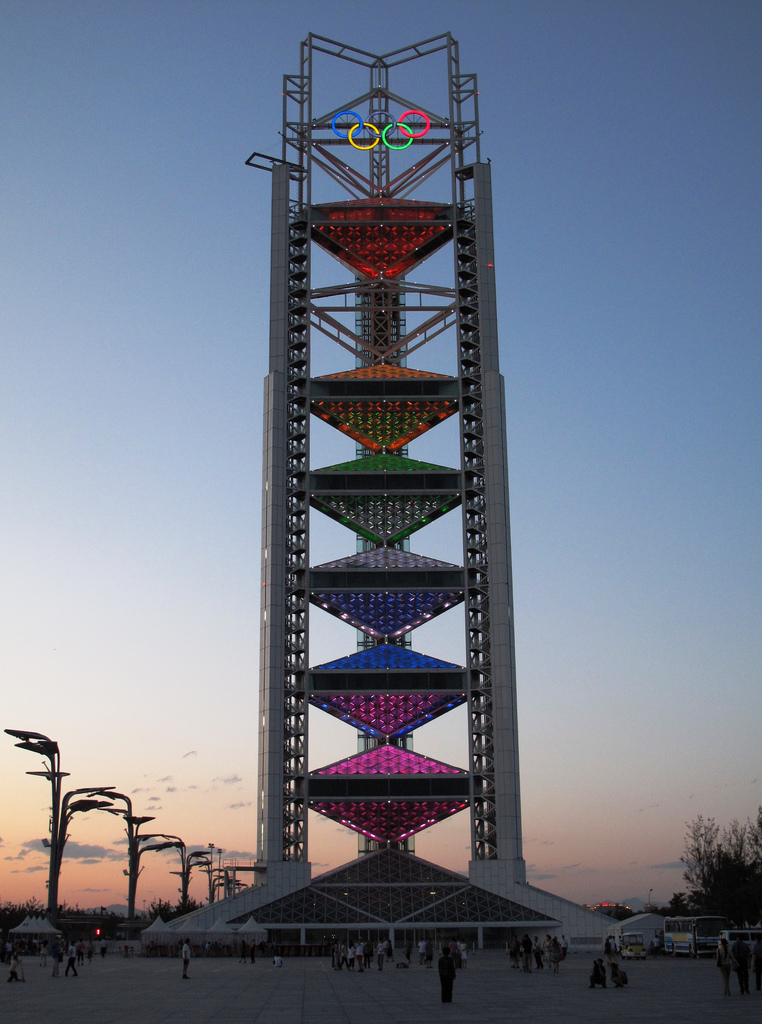
Beijing National Stadium (Bird's Nest, 鸟巢) + National Aquatics Center (Water Cube, 水立方)
also known as Olympic Green: Bird's Nest + Water Cube
10 km · 45 minBird's Nest interior: ¥50 (per Wikipedia)
Centerpiece venues of the 2008 Olympics. Bird's Nest by Herzog & de Meuron (completed 2008); Water Cube by PTW + Arup + CSCEC + CCDI (2007). Water Cube hosted curling at the 2022 Winter Olympics.
Herzog & de Meuron + PTW. Even if you've seen them in photos a thousand times, in person they're propaganda-monumental. Visit at dusk for the floodlights. 30 min from central Beijing.
Be the first to commit
Communist memorial complex · Suggestion✓ verified
Lugou Bridge / Marco Polo Bridge (卢沟桥) + Wanping Fortress
also known as Marco Polo Bridge + Wanping Garrison Town
17 km · 45 min
266.5 m stone arch bridge completed 1192, praised by Marco Polo. The 1937 Marco Polo Bridge Incident here marked the start of the Second Sino-Japanese War. Adjacent 17th-c. Wanping Fortress houses the Museum of the War of Chinese People's Resistance Against Japanese Aggression.
Where the Sino-Japanese War kicked off in 1937. Memorial museum is heavy socialist-realist. The walled Wanping town beside it was preserved 1980s as a 'patriotic education base.' Easy half-day from Beijing.
Be the first to commit
Abandoned · Pinned
Fox Tower
0 km · 18 min
Forgotten Beijing watchtower. Easy add.
Be the first to commit
Food · Pinned✓ verified
Ninety-Nine Yurts
also known as 99dingzhanfang
16 km · 45 min
Mongolian-themed restaurant in Chaoyang District, Beijing, with 50+ individual yurt-style private dining tents. Specialty: spit-roast lamb plus Mongolian and northern Chinese dishes.
Beijing hotpot.
Be the first to commit
Food · Pinned✓ verified
Red Capital Club
4 km · 18 min
Mao-era themed restaurant in a restored 200-year-old courtyard in Dongsi Jiutiao hutong, Beijing. Serves Zhongnanhai Cuisine inspired by dishes favored by Mao, Deng, and other PRC leaders.
Mao-era kitsch dining; touristy but novel.
Be the first to commit
Food · Pinned
Jin Sheng Long
6 km · 45 min
Beijing local.
Be the first to commit
Food · Pinned
Wang Fat Ass Flesh Fire
5 km · 18 min
Beijing; the name alone.
Be the first to commit
Food · Pinned✓ verified
Old Beijing Zhajiangmian Dawang
also known as Lao Beijing Zhajiangmian
9 km · 45 min
Traditional Beijing zhajiangmian (fried-sauce noodle) house with branches including Chongwenmen. Theatrical service: servers shout greetings as guests arrive and applaud as they leave.
Theatrical noodle service, Beijing.
Be the first to commit
▮
Food · Pinned
Zhuangliu Liaoma Tutou
6 km · 45 min
Beijing local.
Be the first to commit
Food · Pinned✓ verified
Slow Boat Brewery
also known as Slow Boat
4 km · 18 min
Beijing craft brewery founded 2011 by Chandler Jurinka and Daniel Hebert. Sanlitun Brewpub at 6 Nan Sanlitun Lu has 36 taps over three floors. Known for Monkey's Fist IPA.
Pedestrian snack alley off Wangfujing Street in Dongcheng, Beijing. Chinese street snacks and skewers. Busiest in evenings.
Scorpion-on-a-stick tourist market. Mostly closed/tamed now but still a stop.
Be the first to commit
Landmark · Pinned✓ verified
China Watermelon Museum (中国西瓜博物馆)
also known as Watermelon Museum
26 km · 45 min
Specialty museum in Pangezhuang Town, Daxing District, Beijing, dedicated to the history and agriculture of watermelons. Building shaped like a giant watermelon flanked by green leaves.
Beijing Daxing. Yes it's real.
Be the first to commit
Landmark · Pinned✓ verified
Beijing World Park
14 km · 45 min
Theme park in southwestern Beijing (Fengtai District) with ~100 scaled-down replicas of famous landmarks from nearly 40 countries.
Mini Eiffel etc. Bizarre and accessible.
Be the first to commit
Landmark · Pinned
Paleozoological Museum
7 km · 45 min
Beijing dinosaur museum.
Be the first to commit
Landmark · Pinned✓ verified
Mansudae Art Studio Museum / Mansudae Art Gallery (만수대창작사)
also known as Mansudae Art Gallery
13 km · 45 min
North Korean state-run gallery in Beijing's 798 Art Zone, opened 2009 as the first overseas outpost of Pyongyang's Mansudae Art Studio (producer of major DPRK monuments such as the Chollima Statue). Sells socialist-realist paintings, bronze, posters, stamps. Scaled-down Chollima replica at the entrance.
North Korean art in Beijing. Niche.
Be the first to commit
Landmark · Pinned✓ verified
Chairman Mao Memorial Hall (毛主席纪念堂)
also known as Mao Memorial Hall
0 km · 18 minFree entry; valid passport required
Final resting place of Mao Zedong on Tiananmen Square. Mausoleum completed 24 May 1977.
Mao mausoleum, Tiananmen. Polarizing experience.
Be the first to commit
Landmark · Pinned
South Beauty
4 km · 18 min
High-end Sichuan chain, Beijing.
Be the first to commit
Brutalist · Suggestion
Capital Museum
5 km · 45 min
Massive bronze cylinder slammed through a stone slab. Underrated, in central Beijing.
Be the first to commit
Communist sports modernism · Suggestion
Workers' Stadium / Workers' Gymnasium
5 km · 45 min
1950s Soviet-style Workers' arena. Rebuilt recently but the gymnasium retains the original look.
Three Zaha Hadid towers, mountain-shaped, 798 area.
Be the first to commit
Brutalist · Suggestion✓ verified
Caochangdi (草场地)
also known as Caochangdi Art District
17 km · 45 min
Urban village and contemporary arts district in Beijing's Chaoyang District near the 5th Ring Road / Airport Expressway. Artists and galleries (incl. studios designed by Ai Weiwei) began moving in around 2000; quieter counterpart to nearby 798.
Ai Weiwei's gray-brick studio district. Quieter than 798, more brutalist.
Be the first to commit
Brutalist · Suggestion
Caochangdi Art District (already in suggestions)
17 km · 45 min
Re-flagging — Ai Weiwei's gray-brick studio district, quieter and more brutalist than 798.
Be the first to commit
Landmark · Pinned
Destination Club
5 km · 18 min
Beijing nightlife; if interested.
Be the first to commit
★Same metro(2)
Landmark · Pinned
Great Wall of China Slide
61 km · 1.0 hr
Mutianyu toboggan down. Pair with the Great Wall visit.
Be the first to commit
Lodging · Pinned
Tianzi Hotel
40 km · 1.0 hr
Shou-Xing-Fu hotel shaped like 3 gods. Hebei, near Beijing — easy detour.
Be the first to commit
★Day trip(5)
★ EssentialLandmark · Pinned✓ verified
Tianjin Binhai Library (天津滨海图书馆)
also known as Tianjin Binhai Library
147 km · 1.8 hr
Five-level public library nicknamed 'The Eye' for its central spherical auditorium ringed by terraced bookshelves. Designed by MVRDV (Rotterdam) with the Tianjin Urban Planning and Design Institute. Opened October 2017.
The 'Eye' library. Spectacular and easy from Beijing (~1h HSR).
Be the first to commit
★ EssentialLandmark · Pinned✓ verified
Hanging Temple / Xuankong Temple (悬空寺)
also known as Hanging Temple of Hengshan
231 km · 2.8 hr
Built into a cliff 75 m above the ground near Mount Heng in Hunyuan County, Shanxi. 40 halls integrating Buddhist, Taoist, and Confucian elements; over 1,500 years old.
Pinned to a cliff for 1500 years. Datong — 4h from Pingyao or Beijing. Pair with Yungang.
Be the first to commit
Landmark · Pinned✓ verified
Da Shuhua
115 km · 1.4 hr
500-year-old folk art performed in Nuanquan Town, Yuxian County, Hebei. Molten iron is thrown against a cold brick wall to create showers of sparks resembling a tree canopy. Traditionally during the Lantern Festival.
Molten iron firework show, Hebei. Specific dates.
Be the first to commit
Faded grandeur · Suggestion
Tianjin Astor Hotel / Italian Concession
109 km · 1.4 hr
Italianate quarter — only one outside Italy. Atmospherically rotting.
Be the first to commit
Concession-era · Suggestion✓ verified
Five Great Avenues / Wudadao
also known as Wudadao (Five Great Avenues)
111 km · 1.4 hr
Upscale residential and tourist quarter in Tianjin's Heping District. 230+ buildings in British, French, Italian, German, and Spanish styles. From the former British concession; the Italian Concession (1901-1943) is a separate quarter.
European-style concessions, half decayed, half gentrified. Pair with Binhai Library.
Be the first to commit
★Overnight side trip(4)
★ EssentialLandmark · Pinned✓ verified
Yungang Grottoes (云冈石窟)
also known as Yungang Grottoes
279 km · 3.1 hr
Northern Wei dynasty Buddhist rock-cut temples ~16 km west of Datong, Shanxi. 53 major caves with ~51,000 statues. UNESCO World Heritage.
Datong cave Buddhas. UNESCO. Pair with Hanging Temple.
also known as Datong Old City (Geng Yanbo's rebuilt walls)
265 km · 3.0 hr
Reconstruction of Datong's historic core launched 2008 by Mayor Geng Yanbo ('Demolition Mayor'), redeveloping over 3 km² and demolishing roughly 200,000 homes. Ming-style city wall rebuilt 2010–end of 2014. Geng left office 2013, leaving a half-finished city center; subject of the documentary 'The Chinese Mayor'.
Mayor Geng Yanbo demolished entire historic neighborhoods 2008-2013 to rebuild a 'Tang dynasty' fake-old city from scratch — bankrupting the city in the process. Empty new-ancient streets inside vast walls. You're already going to Datong for Yungang + Hanging Temple. THIS is the bonus. Watch 'The Chinese Mayor' (2015) before going.
Be the first to commit
Industrial/abandoned · Suggestion
Datong Coal Mine Museum + abandoned tunnels
266 km · 3.0 hr
Real working/decaying Mao-era mining city. You're already going to Datong for Hanging Temple/Yungang.
Be the first to commit
Landmark · Pinned✓ verified
Old Dragon's Head / Laolongtou (老龙头)
also known as End of Great Wall
290 km · 3.1 hr
Easternmost terminus of the Ming Great Wall, where a granite seawall extends into the Bohai Sea south of Shanhaiguan Pass, Hebei. First built 1381; named for resembling a dragon's head dipping into the sea. Part of the Great Wall UNESCO listing.
Shanhaiguan, where wall meets the sea. Doable from Beijing.
Be the first to commit
★Major detour(3)
Landmark · Pinned✓ verified
Erenhot Kissing Sauropods Arch
also known as Kissing Dinosaurs
555 km · 4.6 hr
Highway arch south of Erenhot, built 2006, with two sauropod sculptures depicted as kissing across the road. Smaller dinosaur figures of various species added 2007.
Erenhot border arch. Same area.
Be the first to commit
Landmark · Pinned✓ verified
Erenhot Dinosaur Museum / Erenhot Dinosaur Geopark
also known as Dinosaur Theme Park
559 km · 4.6 hr
Dinosaur-themed museum and geopark in Erenhot, Inner Mongolia, near a region (Iren Dabasu / Iren Nor salt lake) historically significant for major dinosaur fossil discoveries.